2 November 2026
Coral bleaching vs. coral disease: telling them apart on a reef flat
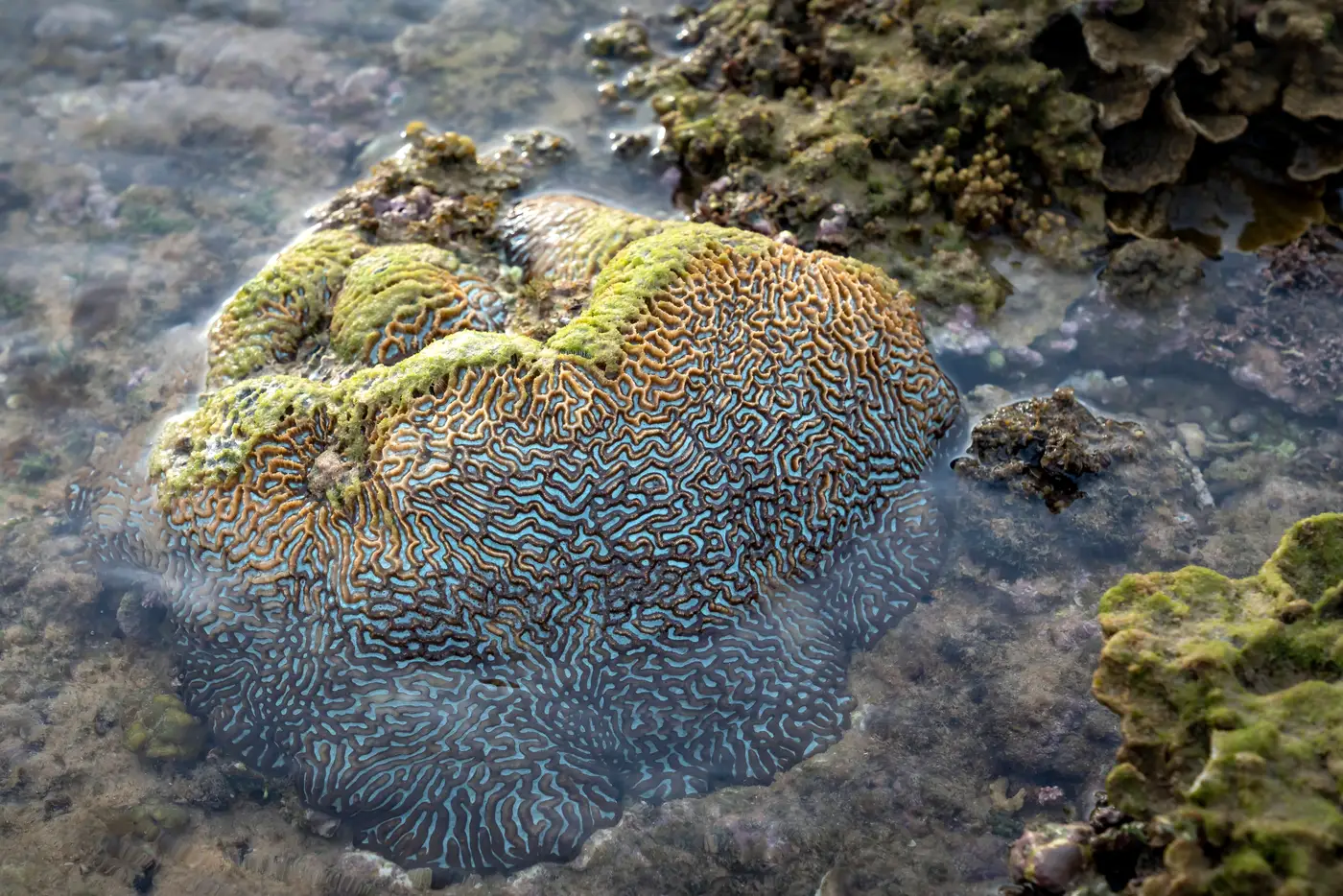
From the gunwale, a pale colony is a pale colony. But if you're writing it up as a bleaching event when it's actually a disease outbreak, your seasonal report is tracking the wrong driver, and your follow-up dive plan will miss the thing killing coral on your reef flat.
Both conditions turn living tissue white or pale. That's about where the similarity ends.
What bleaching looks like up close
Bleaching is the coral expelling its symbiotic algae, usually because water temperature has sat too high for too long. The tissue is still there. It's just gone transparent, so you're seeing the white calcium carbonate skeleton through it rather than the brown-gold of healthy zooxanthellae. A bleached colony can still recover if conditions ease up in time.
A few things to check for:
- The whole colony tends to pale evenly, not in patches with sharp edges.
- Neighboring colonies of the same species often bleach together, since they're responding to the same thermal stress.
- Colony structure stays intact. No exposed skeleton, no tissue sloughing off.
- It tracks with a known heat event. Check your sea surface temperature log before you write "bleaching" on the datasheet.
What disease looks like instead
Disease is tissue death, usually from a pathogen, and it leaves evidence bleaching doesn't. Look for a visible line or band between living tissue and bare, algae-covered skeleton, moving across the colony over days or weeks. That boundary is the tell. Bleached coral doesn't have one, because there's no tissue loss, just loss of pigment.
Common field signs:
- A distinct margin, sometimes a dark band (black band disease), sometimes a diffuse white front (white syndrome), separating live tissue from dead.
- Skeleton exposed behind the lesion gets colonized by turf algae within days, so older lesions look greenish or furred rather than clean white.
- Disease usually hits scattered colonies rather than a whole patch at once, and it isn't tied to a thermal event. You can see it in cool months too.
- Progression is often one-directional across a colony, spreading from a single point rather than appearing all over at once.
The practical shorthand a lot of survey teams use: bleaching turns a colony pale all over, disease eats a colony from one edge. If you can see exposed skeleton with algae already growing on it, you're almost certainly looking at disease or old mortality, not an active bleaching response.
Why the distinction matters for your reef flat indicators
Your seasonal roll-up probably tracks live coral cover, percent bleached, and some flag for disease incidence as separate indicators, because they feed different management responses. A bleaching spike tells you to watch water temperature trends and maybe flag the site for recovery monitoring next season. A disease outbreak tells you something else is going on, water quality, a pathogen vector, stress from sedimentation, and it usually needs a different kind of follow-up, sometimes including pulling samples for lab ID.
Mixing the two in your dataset muddies both signals. A reef flat that's 30% pale could be a thermal bleaching event in progress, or it could be a slow-moving disease front that's been building for months. Your transect notes need to separate them, and that starts with knowing which visual cues point where before the dive team gets in the water.
That's the gap a wide first look is meant to close. A seasonal cover map that separates coral, algae, rubble and sand across the flat, with a flag on where the signature has shifted toward whitening since last season, gives you a shortlist of where to send divers and a reason to go there, rather than a blind sweep of the whole monitoring area. Coral Reef Mapping builds that layer from shallow-water reflectance between surveys, so your team walks in already knowing where the pale patches are before anyone gets wet.
It won't tell you bleaching from disease on its own, that call still belongs to someone in the water with a slate and a camera. But it narrows down where that call needs to be made.
If you're planning your next seasonal pass, it's worth seeing what the flag layer looks like for your own reef flat before the dive team schedules go out.